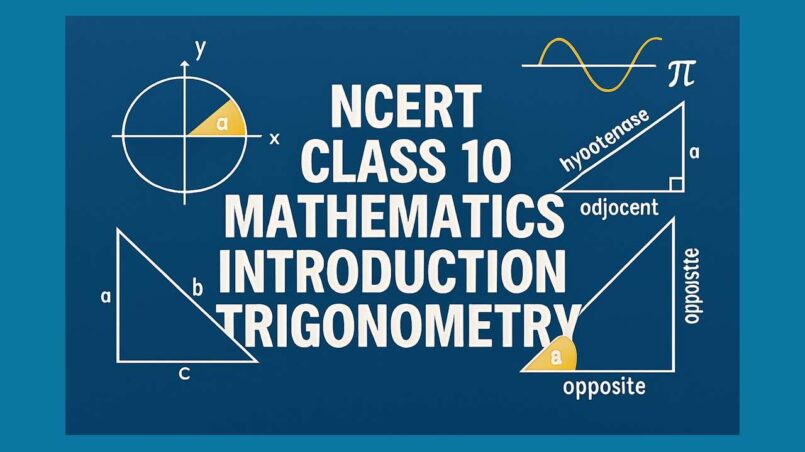
NCERT class10 mathematics Introduction to Trigonometry
Understanding Trigonometry: NCERT Class 10 Mathematics Chapter 8
Trigonometry might be tough but is very interesting. It is detailly covered in the Chapter 8 of the Class 10 Mathematics NCERT textbook, named ‘Introduction to Trigonometry.’ This chapter gave foundation for easily understanding about angles, triangles, and its uses, this chapter is very important for students.
Exercise Solutions
| Exercise 8.1 |
| Exercise 8.2 |
| Exercise 8.3 |
What is Trigonometry?
Trigonometry is easily understood and its all about the angles and sides of triangles, especially right-angled ones, that connect with each other. Chapter 8 digs into basic introducing trigonometric ratios which are- sine (sin), cosine (cos), tangent (tan), cosecant (cosec), secant (sec), and cotangent (cot). These ratios are explained using an acute angle in a right-angled triangle like this:
- \( \sin \theta = \frac{\text{Perpendicular}}{\text{Hypotenuse}} \)
- \( \cos \theta = \frac{\text{Base}}{\text{Hypotenuse}} \)
- \( \tan \theta = \frac{\text{Perpendicular}}{\text{Base}} \)
- The reciprocal ratios are \( \csc \theta = \frac{1}{\sin \theta}, \quad \sec \theta = \frac{1}{\cos \theta}, \quad \cot \theta = \frac{1}{\tan \theta} \).
Key Concepts Covered
1. Trigonometric Ratios of Specific Angles
The chapter let us understand the values for some of the standard angles of trigonometric ratios of angles like- 0°, 30°, 45°, 60°, and 90°.
Here is the table for standard angles of trigonometric values in fraction:
| Function | 0° | 30° | 45° | 60° | 90° |
|---|---|---|---|---|---|
| sin θ | \( 0 \) | \( \frac{1}{2} \) | \( \frac{1}{\sqrt{2}} \) | \( \frac{\sqrt{3}}{2} \) | \( 1 \) |
| cos θ | \( 1 \) | \( \frac{\sqrt{3}}{2} \) | \( \frac{1}{\sqrt{2}} \) | \( \frac{1}{2} \) | \( 0 \) |
| tan θ | \( 0 \) | \( \frac{1}{\sqrt{3}} \) | \( 1 \) | \( \sqrt{3} \) | ND |
| cot θ | ND | \( \sqrt{3} \) | \( 1 \) | \( \frac{1}{\sqrt{3}} \) | \( 0 \) |
| sec θ | \( 1 \) | \( \frac{2}{\sqrt{3}} \) | \( \sqrt{2} \) | \( 2 \) | ND |
| cosec θ | ND | \( 2 \) | \( \sqrt{2} \) | \( \frac{2}{\sqrt{3}} \) | \( 1 \) |
2. Complementary Angles
The most interesting part of this chapter is the link between complementary angles, i.e., angles that adds up to 90°. These relationships enable us to make easy calculation and gives clearer knowledge of how the angles are link to each other. For example:
\( \sin(90^\circ – \theta) = \cos\theta \)
\( \cos(90^\circ – \theta) = \sin\theta \)
\( \tan(90^\circ – \theta) = \cot\theta \)
\( \cot(90^\circ – \theta) = \tan\theta \)
\( \csc(90^\circ – \theta) = \sec\theta \)
\( \sec(90^\circ – \theta) = \csc\theta \hspace{0.5em} \)
These formulae are very essential and powerful tools for simplifying trigonometric problems and deepening our understanding of how angles relate to one another.
3. Trigonometric Identities
There are three fundamental identities in this chapter. These identities are important tools in making simple expressions and solving complex problems, such as proving other trigonometric equations. These are:
\( \sin^2 \theta + \cos^2 \theta = 1 \)
\( 1 + \tan^2 \theta = \sec^2 \theta \)
\( 1 + \cot^2 \theta = \csc^2 \theta \)
These identities are tools for making simple expressions and solving complex problems, such as proving other trigonometric equations.
Why is This Chapter Important?
Trigonometry is beyond numbers, formulae and calculations, it plays an important role in real-life situations like in physics, engineering, astronomy, and navigation. For an example, it can be used in determining the height of a building through the angle of elevation or can figure out distances between objects in space. This chapter gave foundation to these concepts by giving the students the tools that they need in order to solve such practical problems.
Tips for Mastering this Chapter
- Memorizing the trigonometric values for 0°, 30°, 45°, 60°, and 90° is crucial.
- Practicing with diagrams by drawing right-angled triangles help to solve all the problems.
- By understand the identities through practice enable to prove identities in step wise and build confidences in solving.
- Try to solve all the exercises given in the NCERT textbook, this will enable you to cover a wide range of problems, from calculating ratios to proving identities.
Conclusion
The NCERT textbook of Class 10 Mathematics chapter 8 provides clear and simple introduction to trigonometry with combined theory and practical problem-solving. By learning trigonometric ratios, special angles, complementary angles, and key identities, students can develop a strong mathematical based within themselves. Whether the goal is to excel in exams or apply these ideas to real-life situations, this chapter serves as an important step toward appreciating the beauty and logic behind triangles and angles.

Wow nice very nice