The Union of Evangelical Students of India (UESI) is a nationwide Christian student organization that promotes spiritual growth, leadership development, and evangelism among students.
It fosters an interdenominational fellowship, encouraging students to integrate their faith into academic, social, and cultural life while actively engaging in community service and outreach programs. The official website of UESI and it’s URL is https://uesi.in/
Outline:
- History of UESI
- AIMS of UESI
- Vision & Mission Statement of UESI
- Doctrinal Basis of UESI
- Distinctives of UESI
- Core Values of UESI
- Bible Study
- Conclusion
- History Quiz
History of UESI
Let us know how the UESI was formed:

MADRAS ICEU
- In 1949, One Friday evening, some of the college students meet at Prof. Enoch’s home, 190 Poonamallee High Road, Chennai. Follow by week after week.
- Prof. H. Enoch believed that he was encouraged by God to raise a student movement.
- 1950, Br. Bakht Singh told Prof. Enoch about Dr. TN Sterrett teaching Bible School at Jhansi, UP, who was sent by International Fellowship of Evangelical Students (IFES) to pioneer student work in India.
- In 1950-51, God allowed Prof. Enoch and Dr. Sterrett to meet.
- In 1951, First ICEU was formed in Madras.
- Tom Thurley became the first president of Madras ICEU.
VELLORE EU
- In 1950, God sent Dr. John Moody from Australia to be on the staff of CMC, Vellore.
- Students began weekly Gospel meetings from August 1951.
- In November 1951, Evangelical Union was formed in Vellore.
COIMBATORE ICEU
- In 1948, D Jeyapaul, a student of the College of Engineering, Madras, moved to Coimbatore to continue his studies.
- In answer of his prayer, God sent HS Poonnuraj to Coimbatore. God raised up a small prayer cell.
- Coimbatore ICEU was inaugurated in 1952.
Formation of UESI
- The three units met for the first time in Katpadi farm, Vellore.
- The aims and objectives of the three groups Madras ICEU, Vellore EU and Coimbatore ICEU were found to be similar.
- It was felt, they must be united.
- UESI was launched as a national movement on 18th September, 1954.
- UESI was affiliated to IFES (International Fellowship of Evangelical Students) in 1959.
Who are with UESI?
It can be understand by one triangle, where each corner represent Student, EGF and Staff.

AIMS of UESI
- Fellowship – by conducting Weekly Bible Study, Prayer.
- Testimony – by making Historic Christian faith – in Social Service, Academic Excellence.
- Evangelism – by organizing various camps or programs.
- Mission – by outreach programs, Inviting Missionary to motivate us for Missional message.
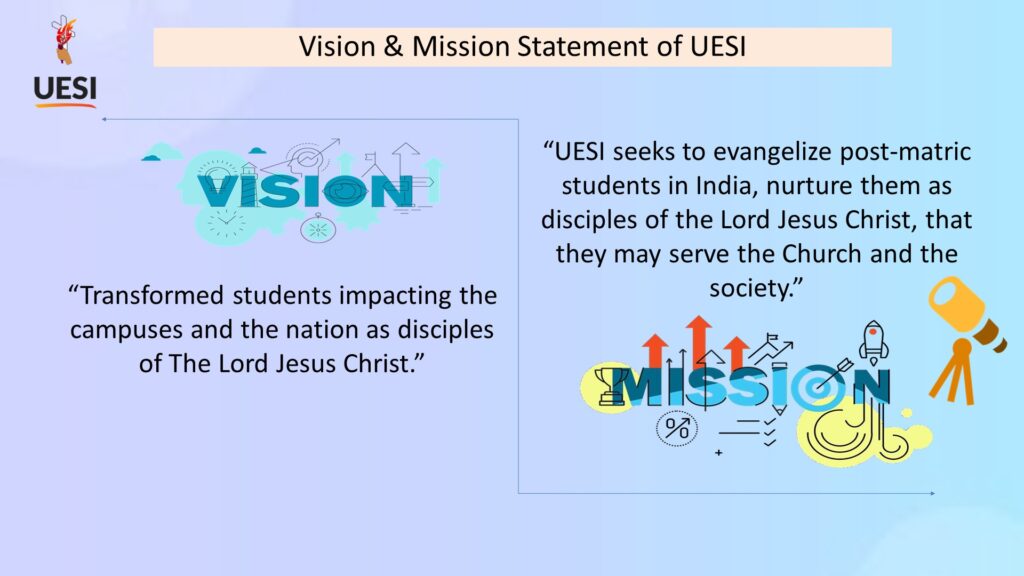
Vision & Mission Statement of UESI
The Mission and Vision statement of UESI are given below:
Doctrinal Basis of UESI
The UESI Statements of Faith consist of ten doctrinal points that are rooted in evangelical, interdenominational, historical, and scriptural principles. To Know the Ten doctrinal points, you may click here.
Distinctives of UESI
It is important to know “What makes UESI unique?” from any other organizations. Distinctives of UESI are given under the table.

| What UESI IS? |
| 1. Bible believing |
| 2. Evangelical |
| 3. Evangelistic |
| 4. Fellowship of new life |
| 5. Interdenominational |
| 6. Spiritually Centered |
| 7. Financially Independent |
| 8. Indian Organization |
| 9. International in its sympathies (IFES) |
| What UESI IS NOT? |
| 1. Not a church |
| 2. Not a sect |
Core Values of UESI
Core values are the deeply held beliefs that define the true essence of an organization. They are not just ideals written on paper but are the enduring principles that shape every decision, action, and interaction.
These foundational values reflect what the organization truly stands for and what it refuses to compromise on, regardless of circumstances. Serving as both identity markers and internal compass points, core values provide direction and consistency in the organization’s pursuit of its mission and goals. They offer a qualitative identity, giving depth and integrity to the organization’s external efforts.
Core Values of UESI
| Centrality of the Word of God | Personal Care | Moral Purity and Financial Integrity |
| Relationship with God | Student Initiative | Shared Leadership |
| Fellowship | Life of Faith and Prayer | Responsibility to Society |
1. Centrality of the Word of God
The Bible stands as the ultimate authority in all matters of life and ministry within UESI. It serves as the touchstone providing clarity, direction, and conviction for everything the movement undertakes.
2. Relationship with God
Intimacy with God is foundational. UESI encourages a personal and deepening relationship with the Lord, influencing every thought, word, and action of those involved in the movement.
3. Fellowship
Fellowship is the lifeblood of UESI. It’s about building authentic, Christ-centered relationships, marked by mutual care, shared burdens, and bearing love for one another.
4. Personal Care
UESI recognizes the unique worth of each individual. Every person is valued, encouraged, and expected to contribute meaningfully to the Kingdom of God, using their God-given gifts and potential.
5. Student Initiative
Students are at the core of the movement. Empowered by the Holy Spirit, they are encouraged to take initiative and lead the charge in witness and outreach on their campuses and beyond.
6. Life of Faith and Prayer
UESI is a movement sustained by prayer and dependent faith. It trusts God wholly, not just for finances but for wisdom, direction, and strength in every step of the journey.
7. Moral Purity and Financial Integrity
High ethical standards are non-negotiable. UESI is committed to moral purity in relationships and absolute integrity in all financial dealings and responsibilities.
8. Shared Leadership
Leadership within UESI is not about power, but about Christ-like servanthood. It is shared, humble, and accountable, by reflecting the spirit of unity and collective responsibility.
9. Responsibility to Society
UESI doesn’t exist in a vacuum. It calls its members to be responsible citizens, by obeying the laws of the land and contributing positively to society, both as individuals and as a community.
Bible Study
Bible study is the process of reading, analyzing, and reflecting on the Bible Scripture with the goal of understanding its message, growing spiritually, and applying its teachings to daily life. It can be done individually or in a group. It’s important to remember, always pray before and after Bible study.
Types of Bible Study:
- Believer Bible Study
- Evangelistic Bible Study
- Personal Bible Study
- Group Bible Study
Key Aspects of Bible Study:
- Reading Scripture
- Observation
- Interpretation
- Application
- Prayer and Reflection
Method of Bible Study
| Inductive Bible Study (IBS) | Deductive Bible Study (DBS) |
| The inductive method starts with observation and moves to interpretation and application. | The deductive method starts with a general idea, theme, or doctrine and looks for Bible verses to support or explain that idea. |
Procedure of IBS
- Never forget to pray.
- Plan your study.
- Read through the whole book, systematically and meditatively.
| Step 1 | Step 2 | Step 3 |
| Observation | Interpretation | Application/Reflection |
Step 1: Observe what is obvious
- Literary form of the passage – Narrative (Story) / Discourse (Teaching) / Poetry (Song)
- Repeated words and phrases
- Keywords
- Connective or Linking words
- Time words
- Location or place words
- Contrasts and Comparisons
- Unknown words
- Figurative expressions
- Apply 7 Fact Finding Questions (7 FFQs) base on:
| Narrative | Discourse | Poetry |
|---|---|---|
| Who · Who wrote the book? · Who are the audience? · Who are the people involved? · Observe who the focus of attention is. · Is there any significance these people? | Who · Who wrote the book? · Who spoke the discourse? · Who are the recipients? · Is there any significance to these titles? | Who · Who is the poet? · Who are the characters mentioned? · Are there any titles or character mentioned about God and others? |
| Where · Where did the event take place? · Where do they come from? · Where are they going? · Is there any significance about these places? | Where · Where is the writer? Where is the speaker? · Where are the recipients? · Where is the location mentioned? · Where is the central location? | Where · Is there any place mentioned in the poetry? · In what sense is the place mentioned? · What purpose does the place mentioned met? |
| When · When did the event take place? · When in history did it take place? · At what point in the life of Jesus? · When in the day/week/month/year did it take place? | When · When did the event take place? · When in history did it take place? · At what point in the life of the speaker? · When in the day/week/month/year did it take place? | When · When did the poet write? · When in history did the poet write? · At what point in the life of poet? · When in the day/week/month/year did it take place? |
| What · Grammar and its significance · Repeated words · Contrasting words · Comparison · Time words · Words with double meaning · Figures of speech · Clause and Phrases · Keywords Context: Historical/Literary/Geographical/Cultural/Social/Religious/political/ethical · What commands/promises are given? · What customs are mentioned? · What does the prominent figure say or do? And what is said about him? · What are events in the passage? | What · Grammar and its significance · Repeated words · Contrasting words · Comparison · Time words · Words with double meaning · Figures of speech · Clause and Phrases · Keywords Context: Historical/Literary/Geographical/Cultural/Social/Religious/political/ethical · What doctrine/truth does the author want to convey? · What reason/illustration/appeal does he use to persuade them? · What were the problems the recipients were facing? · What are the key ideas, teachings and arguments? | What · Grammar and its significance · Repeated words · Contrasting words · Comparison · Order of words · Time words · Words with double meaning · Figures of speech · Clause and Phrases · Keywords Context: Historical/Literary/Geographical/Cultural/Social/Religious/political/ethical · What does it say about God? · What experience did the writer have to inspire his writings? · What is the theme of the poem? · What is the mood of the poem? · What emotion does it convey and what response does it produce? |
| How · How is the passage described? · How are those people, time, place mentioned? · How did the event take place? | How · How is the discourse described? · How did the author express the key theme? · How does certain elements mention? · How did the author start and end? | How · How many themes are expressed? · How did the poet cover the theme? · How did the poet conclude? |
| Why · Why did the writer include this event here? · Why did the event occur? · Why did it happen at this time? · Why is the person involved? · Why did people respond the way they did? · Why are certain things mentioned in certain ways? | Why · Why did the author write this? · Why did it happen? · Why at this time? · Why did people respond the way they did? · Why are certain things mentioned in certain ways? | Why · Why is the poet composing the poem? · Why is poetry in such a mood? · Why is something being said or mentioned? · Why are certain things mentioned in certain ways? |
| So What? · What results follow? How are people affected? · How are the problems relating to ours today? · What is God showing through this passage? · Why does it matter then and now? · How do I apply it? | So What? · What similar problem do I find in the present context? · Who is saying what to whom for what reasons and with what conclusions? · Why does it matter then and now? · How do I apply it? | So What? · What personal experience led the author to reflect and learn what truth about life and God? · What can I find in this poem that relates to me? · Why does it matter then and now? · How to respond to God in similar experience? · How do I apply it? |
| Narrative are normally true-life events narrated by the author in written. Past event documents. | (This column is Discourse) | The Psalms are devotional. They help us reflect and meditate on what God has done for us. They are also a guide to worship. They help us to relate to God honestly. |
| Note: Not all questions are applicable to all passages. | Note: Not all questions are applicable to all passages. | Note: Not all questions are applicable to all passages. |
Step 2: Interpret through the principles of interpretation as the Author intended
- Think of context First
- Near/immediate, far/wider context
- Consider the background
- History
- Geography
- Culture & Cultural Transposition
- Society
- Vocabulary
- What the Author had in mind
- The Scripture interprets the Scripture
- Right use of grammar matters
Step 3: Application – Apply its meaning personally and as the Church understanding, corresponding situation vs corresponding truth.
Quiz Matthew 13
Group-Wise
| 1. House | 2. Sea | 3. Boat | 4. Seed | 5. Root |
| 6. Mustard | 7. Tree | 8. Yeast | 9. Treasure | 10. Pearl |
Scan QR Code or Type https://kahoot.it/

Single-Wise
Scan QR Code or Type https://daorai.in/Matthew13Quiz

Conclusion:
The Union of Evangelical Students of India (UESI) is a vibrant student movement committed to transforming young lives through the Gospel of Jesus Christ. Rooted in the Word of God and guided by strong core values, UESI nurtures discipleship, encourages student leadership, and fosters Christ-centered fellowship.
With a focus on spiritual growth, moral integrity, and social responsibility, UESI equips students to be faithful witnesses and responsible citizens, making a lasting impact in the Church, campus, and society.
Matthew 20:28 (ESV)
“Even as the Son of Man came not to be served but to serve, and to give his life as a ransom for many.”
Saved to Serve
References
- UESI official https://uesi.in/
- UESI Tamil Nadu https://www.uesitn.org/
- Daorai https://daorai.com/blog/know-about-uesi/
Quiz – History of UESI
CA: 2 marks, WA: -0.75 marks and NA: 0 marks
Best of Luck