Topics: Maths Complex Number – Polar Form, Straight Line, Circle, De Moivre’s theorem, Euler’s expansion of cosine and sine, Gregory’s series.
1. What is a Complex Number (\( z = a + b i \))?
A \(\textbf{complex number}\) is a number that has two parts:
A \(\textbf{real part}\) (just a regular number like 2, -5, or 0.7) and An \(\textbf{imaginary part}\) (a number with \(\textit{i}\), where \( i \) is defined as the square root of -1). So, we can write a complex number like this:
\(z = a + bi\)
where, \( a \) is the real part, \( b \) is the imaginary part and \( i \) is the imaginary unit, where \( i^2 = -1 \)
In simple: A complex number combines \(\textit{real numbers}\) and \(\textit{imaginary numbers}\) into one. For examples: \(3 + 4i, \quad -2 + 0i, \quad 0 + 5i \).
Conjugate of Complex Number
The conjugate of a complex number \( z = a + bi \), where \( a \) and \( b \) are real numbers and \( i \) is the imaginary unit (\( i^2 = -1 \)), is denoted \( \bar{z} \) and is given by \( \bar{z} = a – bi \).
Example 1: Let \( z = 5 + 2i \).
Answer: Conjugate of \( z \) is: \( \bar{z} = 5 – 2i \)
Example 2: Let \( z_1 = 5 – 2i \).
Answer: Conjugate of \( z_1 \) is: \( \bar{z_1} = 5 + 2i \)
Example 3: Let \( z_2 = – 5 – 2i \).
Answer: Conjugate of \( z_2 \) is: \( \bar{z_2} = – 5 + 2i \)
Topics
| Properties of Modulus CN | Polar Form of CN |
| Ordered Pair of CN | CE of Straight Line |
| Geometrical Representation of CN | CE of Circle |
| De Moivre’s Theorem | Euler’s Expansion |
| Gregory’s series | Miscellaneous |
Properties of modulus of a complex number
- \( z = 0 \iff z = 0 \text{ i.e., } \text{Re}(z) = 0 \text{ and } \text{Im}(z) = 0 \)
- \( \overline{z} = z = -z \)
- \( -|z| \leq \text{Re}(z) \leq |z| \text{ and } -|z| \leq \text{Im}(z) \leq |z| \)
- \( z \overline{z} = |z|^2, \quad \overline{z} z = |z|^2 \)
- \( \frac{1}{z_1 z_2} = \frac{1}{z_1} \cdot \frac{1}{z_2}, \quad (z_1 z_2 \neq 0) \)
- \( |z_1 + z_2|^2 = |z_1|^2 + |z_2|^2 + 2 \text{Re}(z_1 \overline{z_2}) \)
- \( |z_1 – z_2|^2 = |z_1|^2 + |z_2|^2 – 2 \text{Re}(z_1 \overline{z_2}) \)
- \( |z_1 + z_2| \leq |z_1| + |z_2| \)
- \( |z_1 – z_2| \geq ||z_1| – |z_2|| \)
- \( |a z_1 – b z_2|^2 + |b z_1 + a z_2|^2 = (|a|^2 + |b|^2)(|z_1|^2 + |z_2|^2) \)
- In particular: \( |z_1 – z_2|^2 + |z_1 + z_2|^2 = 2 (|z_1|^2 + |z_2|^2) \)
- The multiplicative inverse (reciprocal) of a complex number \(z = a + ib (\neq 0)\): \( \frac{1}{z} = \frac{a – ib}{a^2 + b^2} = \frac{\overline{z}}{|z|^2}, \quad z = a + ib (\neq 0) \)
Complex number as an ordered pair of real numbers
A complex number as an ordered pair of real numbers means writing any complex number in the form \((a, b)\), where:
- \(a\) is the real part
- \(b\) is the imaginary part (without the \(i\))
This ordered pair \((a, b)\) represents the complex number \(a + ib\). For example:
- \(2+3i → (2,3) \)
- \(−1+4i → (−1,4)\)
- \(5 → (5,0)\)
- \(3i → (0,3)\)
This is called representing complex numbers as ordered pairs of real numbers.
- The first number (a) is the real part
- The second number (b) is the imaginary part
Finding for \( z_1 + z_2 \), \( z_1 – z_2 \), \(z_1 \cdot z_2 \) and \( z_1 \div z_2 \)
Let’s say we have two complex numbers: \(z_1=(a,b)\) and \(z_2=(c,d)\)
These represent \(z_1=a+bi \) and \(z_2=c+di\)
(i) Addition: \((a,b)+(c,d)=(a+c, b+d)\) or \((a+c)+(b+d)i\)
Proof: \(z_1+z_2=(a+bi)+(c+di)\)
\(=(a+c)+(b+d)i\)
\(=(a+c, b+d)\) \( \qquad \) [as \(a+bi =(a, b)\)]
(ii) Subtraction: \((a,b)-(c,d)=(a-c, b-d)\) or \((a-c)+(b-d)i\)
\(\textbf{Proof:}\) Let \( z_1 = a + bi \) and \( z_2 = c + di \)
\( z_1 – z_2 = (a + bi) – (c + di) \)
\(= (a – c) + (b – d)i\)
\(= (a – c,\, b – d) \qquad \text{[as } a + bi = (a, b) \text{]}\)
(iii) Multiplication: \((a,b)\cdot(c,d) = (ac – bd, ad + bc)\) or \((ac – bd) + (ad + bc)i\)
\(\textbf{Proof:}\) Let \( z_1 = a + bi \) and \( z_2 = c + di \)
\(z_1 \cdot z_2 = (a + bi)(c + di)\)
\(= ac + adi + bci + bdi^2\)
\(= ac + (ad + bc)i + bd(-1)\)
\(= (ac – bd) + (ad + bc)i\)
\(= (ac – bd,\, ad + bc) \qquad \text{[as } a + bi = (a, b) \text{]}\)
(iv) Division: \((a,b) \div (c,d) = \left( \frac{ac + bd}{c^2 + d^2}, \frac{bc – ad}{c^2 + d^2} \right)\) or \(\frac{ac + bd}{c^2 + d^2} + \frac{bc – ad}{c^2 + d^2}i\)
\(\textbf{Proof:}\) Let \( z_1 = a + bi \) and \( z_2 = c + di \)
\(\frac{z_1}{z_2} = \frac{a + bi}{c + di}\)
Multiply numerator and denominator by the conjugate of the denominator:
\(= \frac{(a + bi)(c – di)}{(c + di)(c – di)}\)
\(= \frac{ac – adi + bci – bdi^2}{c^2 – (di)^2}\)
\(= \frac{ac + bd + (bc – ad)i}{c^2 + d^2}\)
\(= \frac{ac + bd}{c^2 + d^2} + \frac{bc – ad}{c^2 + d^2}i\)
\(= \left( \frac{ac + bd}{c^2 + d^2}, \frac{bc – ad}{c^2 + d^2} \right) \qquad \text{[as } a + bi = (a, b) \text{]}\)
Example 1: Let \(z_1=(2,3)\) and \(z_2=(4,−1)\). Find \(z_1 + z_2\)
Solution: Given, \(z_1=(2,3)\) and \(z_2=(4,−1)\)
\(z_1 + z_2=(2,3)+(4,−1)\)
\(=(2+4,3+(−1))\)
\(=(6,2)\) \(\quad \text{or} \quad 6+2i\)
Example 2: Let \( z_1 = (-5, 7) \) and \( z_2 = (3, -4) \). Find \( z_1 + z_2 \)
Solution: Given, \( z_1 = (-5, 7) \) and \( z_2 = (3, -4) \)
\(z_1 + z_2 = (-5, 7) + (3, -4) \)
\(= (-5 + 3, 7 + (-4))\)
\(= (-2, 3) \quad \text{or} \quad -2 + 3i\)
Exercise: Find \( z_1 + z_2 \), \( z_1 – z_2 \), \(z_1 \cdot z_2 \) and \( z_1 \div z_2 \)
i. \( z_1 = (1, -2) \) and \( z_2 = (3, 5) \),
ii. \( z_1 = (-4, 6) \) and \( z_2 = (2, -3) \)
iii. \( z_1 = (0, 7) \) and \( z_2 = (-5, -2) \),
iv. \( z_1 = (8, -1) \) and \( z_2 = (-3, 4) \)
v. \( z_1 = (-6, -3) \) and \( z_2 = (6, 3) \)
Complex Number in Polar Form
A complex number \( z = a + bi \), where \( a \) and \( b \) are real numbers and \( i \) is the imaginary unit \(( i^2 = -1 )\), can be expressed in polar form as:
\(z = r (\cos \theta + i \sin \theta)\)
or equivalently, using Euler’s formula:
\(z = r e^{i \theta}\)
Components of Polar Form
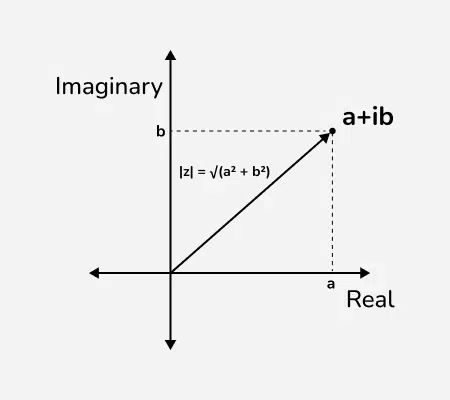
1. \(\textbf{Modulus (\( r \))}\): The magnitude or distance from the origin to the point \((a, b)\) in the complex plane, calculated as: \( r = |z| = \sqrt{a^2 + b^2}\)
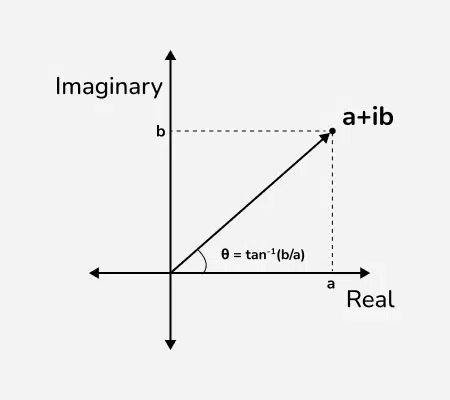
2. \(\textbf{Argument}\) \(( \theta )\): The angle measured from the positive real axis to the line connecting the origin to the point \((a, b)\), typically in radians, found using: \(\theta = \tan^{-1}\left(\frac{b}{a}\right)\)
The value of \( \theta \) depends on the quadrant of the complex plane:
Quadrant I (\( a > 0, b > 0 \)): Use \( \theta = \tan^{-1}(b/a) \).
Quadrant II (\( a < 0, b > 0 \)): Use \( \theta = \pi + \tan^{-1}(b/a) \).
Quadrant III (\( a < 0, b < 0 \)): Use \( \theta = – \pi + \tan^{-1}(b/a) \).
Quadrant IV (\( a > 0, b < 0 \)): Use \( \theta = \tan^{-1}(b/a) \) or \( \theta = 2\pi + \tan^{-1}(b/a) \).
If ( x = 0 ), then: \(\theta = \frac{\pi}{2} \quad \text{if } y > 0 \quad \text{and} \quad \theta = -\frac{\pi}{2} \quad \text{if } y < 0\).
Special cases: Adjust for points on axes (e.g., \( \theta = 0, \pi/2, \pi, 3\pi/2 \)) when \( a = 0 \) or \( b = 0 \).
| Function | 0° | 30° | 45° | 60° | 90° |
|---|---|---|---|---|---|
| \(\theta\) | 0 | \(\frac{\pi}{6}\) | \(\frac{\pi}{4}\) | \(\frac{\pi}{3}\) | \(\frac{\pi}{2}\) |
| sin θ | \( 0 \) | \( \frac{1}{2} \) | \( \frac{1}{\sqrt{2}} \) | \( \frac{\sqrt{3}}{2} \) | \( 1 \) |
| cos θ | \( 1 \) | \( \frac{\sqrt{3}}{2} \) | \( \frac{1}{\sqrt{2}} \) | \( \frac{1}{2} \) | \( 0 \) |
| tan θ | \( 0 \) | \( \frac{1}{\sqrt{3}} \) | \( 1 \) | \( \sqrt{3} \) | UD |
| cot θ | UD | \( \sqrt{3} \) | \( 1 \) | \( \frac{1}{\sqrt{3}} \) | \( 0 \) |
| sec θ | \( 1 \) | \( \frac{2}{\sqrt{3}} \) | \( \sqrt{2} \) | \( 2 \) | UD |
| cosec θ | UD | \( 2 \) | \( \sqrt{2} \) | \( \frac{2}{\sqrt{3}} \) | \( 1 \) |
1. Convert \( z = 1 + i \) to polar form.
Solution: Given \( z = 1 + i \), here a =1 and b = 1
Modulus (r) \( = \sqrt{a^2 + b^2} = \sqrt{1^2 + 1^2} \)
\( = \sqrt{1 + 1} = \sqrt{2} \)
Argument (\(\theta\)): Since \( a = 1 \), \( b = 1 \), and both are positive, the number is in the first quadrant.
\(\theta = \tan^{-1}\left(\frac{b}{a}\right) = \tan^{-1}\left(\frac{1}{1}\right) = \tan^{-1}(1) = \frac{\pi}{4} \)
So, In polar form:
\(z = \sqrt{2}\left(\cos\frac{\pi}{4} + i\sin\frac{\pi}{4}\right) \)
Alternatively, using Euler’s formula:
\(z = \sqrt{2} e^{i\frac{\pi}{4}}\)
Verification: Since \( \cos\frac{\pi}{4} = \sin\frac{\pi}{4} = \frac{\sqrt{2}}{2} \),
\( \sqrt{2}\left(\cos\frac{\pi}{4} + i\sin\frac{\pi}{4}\right) = \sqrt{2}\left(\frac{\sqrt{2}}{2} + i\frac{\sqrt{2}}{2}\right) \)
\( = \frac{\sqrt{2} \cdot \sqrt{2}}{2} + i\frac{\sqrt{2} \cdot \sqrt{2}}{2} = 1 + i \)
which matches the original number.
2. Convert \( z = -1 + i \) to polar form.
Solution: Given \( z = -1 + i \), here \( a = -1 \) and \( b = 1 \).
Modulus (r): \(= \sqrt{a^2 + b^2} = \sqrt{(-1)^2 + 1^2} \)
\( = \sqrt{1 + 1} = \sqrt{2} \)
Argument \((\theta)\): Since \( a = -1 < 0 \), \( b = 1 > 0 \), the number is in the second quadrant.
\(\theta = \pi + \tan^{-1}\left(\frac{b}{a}\right) \)
\( = \pi + \tan^{-1}\left(\frac{1}{-1}\right) \)
\( = \pi + \tan^{-1}(-1) \)
\( = \pi – \tan^{-1} \cdot \tan \frac{\pi}{4} \)
\( = \pi -\frac{\pi}{4} \)
\( = \frac{3\pi}{4}\)
(Note: \( \frac{3\pi}{4} \) satisfies \( \frac{\pi}{2} < \frac{3\pi}{4} < \pi \), confirming it is in the second quadrant.)
So, In polar form:
\(z = \sqrt{2}\left(\cos\frac{3\pi}{4} + i\sin\frac{3\pi}{4}\right)\)
Alternatively, using Euler’s formula:
\(z = \sqrt{2} e^{i\frac{3\pi}{4}}\)
Verification: Since \( (\cos\frac{3\pi}{4} = -\frac{\sqrt{2}}{2} ), ( \sin\frac{3\pi}{4} = \frac{\sqrt{2}}{2} )\),
\( \sqrt{2}\left(\cos\frac{3\pi}{4} + i\sin\frac{3\pi}{4}\right) = \sqrt{2}\left(-\frac{\sqrt{2}}{2} + i\frac{\sqrt{2}}{2}\right) \)
\( = -\frac{\sqrt{2} \cdot \sqrt{2}}{2} + i\frac{\sqrt{2} \cdot \sqrt{2}}{2} = -1 + i \)
which matches the original number.
3. Convert \( z = -1 – i \) to polar form.
Solution: Given \( z = -1 – i \), here \( a = -1 \) and \( b = -1 \).
Modulus (r): \(= \sqrt{a^2 + b^2} = \sqrt{(-1)^2 + (-1)^2} \)
\( = \sqrt{1 + 1} = \sqrt{2} \)
Argument (\(\theta\)): Since \( a = -1 < 0 \), \( b = -1 < 0 \), the number is in the third quadrant.
\(\theta = – \pi + \tan^{-1}\left(\frac{b}{a}\right) \)
\( = – \pi + \tan^{-1}\left(\frac{-1}{-1}\right) \)
\( = – \pi + \tan^{-1}(1) \)
\( = – \pi + \tan^{-1} \cdot \tan \frac{\pi}{4} \)
\( = – \pi + \frac{\pi}{4} \)
\( = – \frac{3\pi}{4}\)
(Note: \( -\frac{3\pi}{4} \) satisfies \( -\pi < -\frac{3\pi}{4} < -\frac{\pi}{2} \), confirming it is in the third quadrant.)
So, In polar form:
\(z = \sqrt{2}\left(\cos\left(-\frac{3\pi}{4}\right) + i\sin\left(-\frac{3\pi}{4}\right)\right)\)
Alternatively, using Euler’s formula:
\(z = \sqrt{2} e^{i\left(-\frac{3\pi}{4}\right)} \)
Verification: Since \( \cos\left(-\frac{3\pi}{4}\right) = \cos\left(\frac{3\pi}{4}\right) = -\frac{\sqrt{2}}{2} \), \( \sin\left(-\frac{3\pi}{4}\right) = -\sin\left(\frac{3\pi}{4}\right) = -\frac{\sqrt{2}}{2} \),
So, \(\sqrt{2}\left(\cos\left(-\frac{3\pi}{4}\right) + i\sin\left(-\frac{3\pi}{4}\right)\right) \)
\(= \sqrt{2}\left(-\frac{\sqrt{2}}{2} + i\left(-\frac{\sqrt{2}}{2}\right)\right) \)
\( = -\frac{\sqrt{2} \cdot \sqrt{2}}{2} – i\frac{\sqrt{2} \cdot \sqrt{2}}{2} = -1 – i \)
which matches the original number.
4. Convert \( z = 1 – i \) to polar form.
Solution: Given \( z = 1 – i \), here \( a = 1 \) and \( b = -1 \).
Modulus (r): \(= \sqrt{a^2 + b^2} = \sqrt{1^2 + (-1)^2} \)
\(= \sqrt{1 + 1} = \sqrt{2}\)
Argument (\(\theta\)): Since ( a = 1 > 0 ), ( b = -1 < 0 ), the number is in the fourth quadrant.
\(\theta = \tan^{-1}\left(\frac{b}{a}\right) \)
\(= \tan^{-1}\left(\frac{-1}{1}\right) \)
\(= \tan^{-1}(-1) = -\frac{\pi}{4} \)
(Note: \( -\frac{\pi}{4} \) satisfies \( -\frac{\pi}{2} < -\frac{\pi}{4} < 0 \), confirming it is in the fourth quadrant.)
So, in polar form:
\(z = \sqrt{2}\left(\cos\left(-\frac{\pi}{4}\right) + i\sin\left(-\frac{\pi}{4}\right)\right)\)
Alternatively, using Euler’s formula:
\(z = \sqrt{2} e^{i\left(-\frac{\pi}{4}\right)}\)
Verification: Since \( \cos\left(-\frac{\pi}{4}\right) = \cos\left(\frac{\pi}{4}\right) = \frac{\sqrt{2}}{2} ), ( \sin\left(-\frac{\pi}{4}\right) = -\sin\left(\frac{\pi}{4}\right) = -\frac{\sqrt{2}}{2} \),
\( \sqrt{2}\left(\cos\left(-\frac{\pi}{4}\right) + i\sin\left(-\frac{\pi}{4}\right)\right) \)
\( = \sqrt{2}\left(\frac{\sqrt{2}}{2} + i\left(-\frac{\sqrt{2}}{2}\right)\right) \)
\( = \frac{\sqrt{2} \cdot \sqrt{2}}{2} – i\frac{\sqrt{2} \cdot \sqrt{2}}{2} = 1 – i\)
which matches the original number.
5. Convert \( z = \frac{-16}{1 + i\sqrt{3}} \) to polar form.
Solution: To find the polar form of \( z \), we first compute \( z \) in rectangular form \(( a + bi )\), then convert it to polar form.
Given \( z = \frac{-16}{1 + i\sqrt{3}} \), rationalize the denominator by multiplying numerator and denominator by the conjugate of the denominator, \( 1 – i\sqrt{3} \):
\(z = \frac{-16}{1 + i\sqrt{3}} \cdot \frac{1 – i\sqrt{3}}{1 – i\sqrt{3}} \)
\(= \frac{-16(1 – i\sqrt{3})}{(1)^2 – (i\sqrt{3})^2} \)
\(= \frac{-16 + 16i\sqrt{3}}{1 – i^2 \cdot 3} \)
\(= \frac{-16 + 16i\sqrt{3}}{1 – (-3)} \)
\(= \frac{-16 + 16i\sqrt{3}}{4}\)
\(z = \frac{-16}{4} + \frac{16i\sqrt{3}}{4} = -4 + 4i\sqrt{3}\)
So, \( z = -4 + 4i\sqrt{3} \), where \( a = -4 \), \( b = 4\sqrt{3} \).
Modulus (r): \(= \sqrt{a^2 + b^2} = \sqrt{(-4)^2 + (4\sqrt{3})^2} \)
\(= \sqrt{16 + 16 \cdot 3} = \sqrt{16 + 48} = \sqrt{64} = 8\)
Argument (\(\theta\)): Since \( a = -4 < 0 \), \( b = 4\sqrt{3} > 0 \), the number is in the second quadrant.
\(\theta = \tan^{-1}\left(\frac{b}{a}\right) \)
\(= \tan^{-1}\left(\frac{4\sqrt{3}}{-4}\right) \)
\(= \tan^{-1}(-\sqrt{3})\)
Since \( \tan(\frac{\pi}{3}) = \sqrt{3} \), we have \( \tan^{-1}(-\sqrt{3}) = -\frac{\pi}{3} \). Adjust for the second quadrant:
\(\theta = \pi -\frac{\pi}{3} = \frac{2\pi}{3}\)
(Note: \( \frac{2\pi}{3} \) satisfies \( \frac{\pi}{2} < \frac{2\pi}{3} < \pi \), confirming it is in the second quadrant.)
So, in polar form:
\(z = 8\left(\cos\frac{2\pi}{3} + i\sin\frac{2\pi}{3}\right)\)
Alternatively, using Euler’s formula:
\(z = 8 e^{i\frac{2\pi}{3}} \)
Verification: Since \(( \cos\frac{2\pi}{3} = -\frac{1}{2} ), ( \sin\frac{2\pi}{3} = \frac{\sqrt{3}}{2}) \),
So, \( 8\left(\cos\frac{2\pi}{3} + i\sin\frac{2\pi}{3}\right) \)
\( = 8\left(-\frac{1}{2} + i\frac{\sqrt{3}}{2}\right) \)
\( = -4 + 4i\sqrt{3} \)
which matches the original form \( z = -4 + 4i\sqrt{3} \).
Exercise: Express in polar form of the following complex number.
- \( z = 3 + 3i \)
- \( z = -2 + 2i\sqrt{3} \)
- \( z = -4 – 4i \)
- \( z = 5 – 5i\sqrt{3} \)
- \( z = \frac{8}{1 + i} \)
- \( z = -1 – i\sqrt{3} \)
- \( z = \frac{-6}{1 – i\sqrt{3}} \)
- \( z = 2 + i\sqrt{2} \)
- \( z = -3 + i \)
- \( z = \frac{4}{i – 1} \)
Geometrical Representation of Complex Number
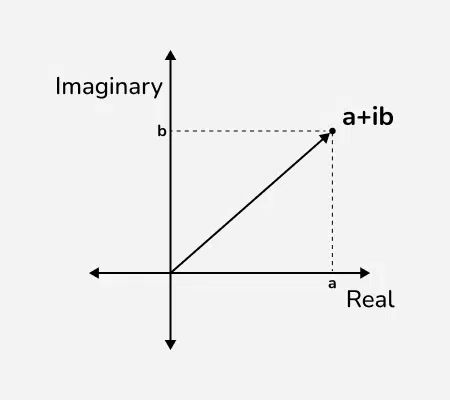
A complex number \( z = a + bi \), where \( a \) and \( b \) are real numbers and \( i \) is the imaginary unit (\( i^2 = -1 \)), can be represented geometrically on a two-dimensional plane called the Argand plane or complex plane. Here’s a concise explanation of its geometrical representation:
The Argand plane is a Cartesian coordinate system where:
- The horizontal axis (x-axis) is the real axis, representing the real part \( a \).
- The vertical axis (y-axis) is the imaginary axis, representing the imaginary part \( b \).
A complex number \( z = a + bi \) is plotted as the point \( (a, b) \) in this plane.
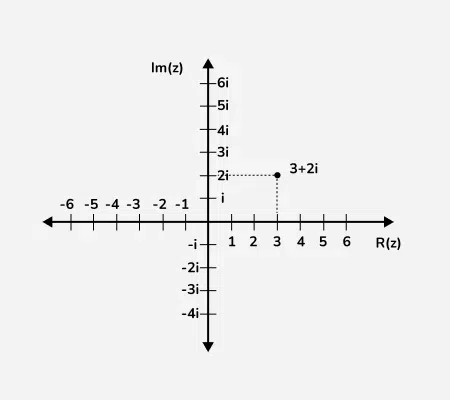
Example 1: Plot the complex number \(z=3+2i\) on the complex plane.
Solution: Given: \( z = 3 + 2i \)
The complex number \( z \) corresponds to the point \( (3, 2) \) in the complex plane. We plot this point on the graph below, where the x-axis represents the real part and the y-axis represents the imaginary part.
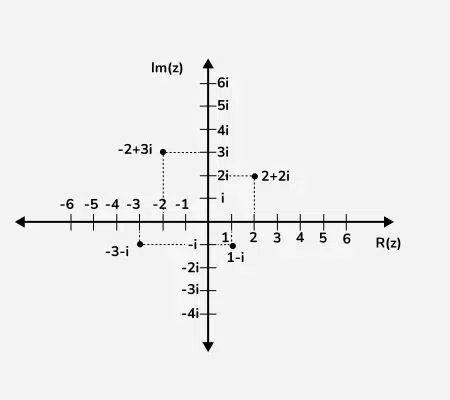
Example 2: Plot the complex numbers \(z_1 = 2 + 2i\), \(z_2 = -2 + 3i\), \(z_3 = -3 – i\), and \(z_4 = 1 – i\) on the complex plane.
Solution: Given: \(z_1 = 2 + 2i\), \(z_2 = -2 + 3i\), \(z_3 = -3 – i\), and \(z_4 = 1 – i\)
In the complex plane, the x-axis represents the real part, and the y-axis represents the imaginary part. Each complex number \(z = a + bi\) is plotted as the point \((a, b)\):
For \(z_1 = 2 + 2i\), plot the point (2,2)
For \(z_2 = -2 + 3i\), plot the point (−2,3)
For \(z_3 = -3 – i\), plot the point (−3,−1)
For \(z_4 = 1 – i\), plot the point (1,−1)
Exercise 1: Plot the following complex numbers on the complex plane and find their conjugates:
- \(z_a = 4 + 3i\)
- \(z_b= -1 + 2i\)
- \(z_c = 7 – 4i\)
- \(z_d = -3 + 5i\)
Exercise 2: Plot the complex numbers \(z_1 = 4 + 2i\), \(z_2 = 5 + i\), \(z_3 = -3 – 5i\), \(z_4 = -6 + 6i\) and \(z_5 = 7 – 3i\) on the Argand plane.
Complex Equation of a Straight Line
A straight line in the complex plane can be represented by an equation involving a complex number \(z=x+yi\). The general form of the equation for a straight line is: \(\bar{a}z + a\bar{z} + b=0\). where:
- \(a\) is a complex number,
- \(\bar{a}\) is the complex conjugate of \(a\),
- \(b\) is a real number.
Deriving the complex equation of a straight line
To derive the complex equation of a straight line in the complex plane from the Cartesian equation \( ax + by + c = 0 \), by assuming \( p = a + ib \), we aim to express it in the form of \( \bar{p} z + p \bar{z} + d = 0 \).
Derivation:
We know that, the Cartesian equation of a straight line is: \(ax + by + c = 0 \)
where \( a, b, c \in \mathbb{R} \), and we assume \( a \) and \( b \) are not both zero to define a line.
In the complex plane, let: \( z = x + yi \), where \( x, y \in \mathbb{R} \), so it’s conjugate is \( \bar{z} = x – yi \), and \( p = a + ib \), where \( a, b \in \mathbb{R} \), it’s conjugate is \( \bar{p} = a – ib \).
Now, solving \(z + \bar{z}\) and \(z – \bar{z}\), we have
\( x = \frac{z + \bar{z}}{2}, \quad y = \frac{z – \bar{z}}{2i} \)
Since \( \frac{1}{i} = -i \), rewrite \( y \):
\( y = \frac{z – \bar{z}}{2i} \cdot \frac{i}{i} = \frac{i(z – \bar{z})}{2i \cdot i} = \frac{i(z – \bar{z})}{-2} = \frac{i(\bar{z} – z)}{2} \)
Substituting the value of \( x \) and \( y \) into the Cartesian equation \( ax + by + c = 0 \):
\( a \left( \frac{z + \bar{z}}{2} \right) + b \left( \frac{i(\bar{z} – z)}{2} \right) + c = 0 \)
Multiplying by 2 to clear denominators:
\( a(z + \bar{z}) + b \cdot i(\bar{z} – z) + 2c = 0 \)
Now, \(a z + a \bar{z} + i b \bar{z} – i b z + 2c = 0\)
Group the coefficients of \( z \) and \( \bar{z} \):
\( (a – i b)z + (a + i b)\bar{z} + 2c = 0 \)
Since \( p = a + ib \), \(\bar{p} = a – ib\), and Let \( d = 2c \), where \( d \) is real since \( c \) is real.
Thus, the equation becomes:
\( \bar{p} z + p \bar{z} + d = 0 \)
Slope from p
\(\text{slope} = -\frac{\Re(p)}{\Im(p)} = -\frac{b}{a} \quad \text{(if } b \ne 0\text{)}\)
Question 1: The complex equation of a straight line is given by: \( (2 – 3i)z + (2 + 3i)\bar{z} – 10 = 0 \)
- \(\textbf{(a)}\) Express this equation in Cartesian form.
- \(\textbf{(b)}\) Find the slope of the line.
- \(\textbf{(c)}\) Determine whether the point \( z = 1 + i \) lies on the line.
Solution: \(\textbf{(a) Cartesian Form:}\)
Let \( z = x + iy \), then \( \bar{z} = x – iy \)
Substitute into the given equation:
\( (2 – 3i)(x + iy) + (2 + 3i)(x – iy) – 10 = 0 \)
Expand the first term:
\( (2 – 3i)(x + iy) = 2x + 2iy – 3ix – 3i^2y = 2x + 2iy – 3ix + 3y = (2x + 3y) + i(2y – 3x) \)
Expand the second term:
\( (2 + 3i)(x – iy) = 2x – 2iy + 3ix – 3i^2y = 2x – 2iy + 3ix + 3y = (2x + 3y) + i(3x – 2y) \)
Now add both:
Real part: \( (2x + 3y) + (2x + 3y) = 4x + 6y \)
Imaginary part: \( (2y – 3x) + (3x – 2y) = 0 \)
So the expression becomes:
\( 4x + 6y – 10 = 0 \)
\( = \boxed{2x + 3y = 5} \) (Divided by 2)
\(\textbf{(b) Slope of the Line:}\)
From the Cartesian form \( 2x + 3y = 5 \), rewrite in slope-intercept form:
\( 3y = -2x + 5 \Rightarrow y = -\frac{2}{3}x + \frac{5}{3} \)
So, the slope is:
\( \boxed{-\frac{2}{3}} \)
Alternatively, from \( p = 2 + 3i \), we use:
\( \text{slope} = -\frac{\text{Re}(p)}{\text{Im}(p)} = -\frac{2}{3} \)
\(\textbf{(c) Check if ( z = 1 + i ) lies on the line:}\)
Then \( \bar{z} = 1 – i \). Plug into the original equation:
\( (2 – 3i)(1 + i) + (2 + 3i)(1 – i) – 10 \)
First term: \( (2 – 3i)(1 + i) = 2 + 2i – 3i – 3i^2 = 2 – i + 3 = 5 – i \)
Second term: \( (2 + 3i)(1 – i) = 2 – 2i + 3i – 3i^2 = 2 + i + 3 = 5 + i \)
Add: \( (5 – i) + (5 + i) = 10 \)
Then \( 10 – 10 = 0 \Rightarrow \boxed{\text{Yes, the point lies on the line}} \)
Question 2: Find the equation of the straight line passing through the complex points \(z_1 = 2 + 3i\) and \(z_2 = 4 + i\)
Solution: To derive the complex equation that the line passes through \( z_1 = 2 + 3i \) and \( z_2 = 4 + i \). Substitute these into \( \bar{p}z + p\bar{z} + d = 0 \):
For \( z_1 = 2 + 3i \), \( \bar{z}_1 = 2 – 3i \):
\(\bar{p}(2 + 3i) + p(2 – 3i) + d = 0. \tag{1} \) Equation (1)
For \( z_2 = 4 + i \), \( \bar{z}_2 = 4 – i \):
\(\bar{p}(4 + i) + p(4 – i) + d = 0. \tag{2} \) Equation (2)
Let \( p = a + ib \), so \( \bar{p} = a – ib \).
So, the general form of equation is (a – ib)(2 + 3i) + (a + ib)(2 – 3i) + d = 0.
Now, \((a – ib)(2 + 3i) = 2a + 3ai – 2ib + 3b = (2a + 3b) + i(3a – 2b) \),
\((a + ib)(2 – 3i) = 2a – 3ai + 2ib + 3b = (2a + 3b) + i(-3a + 2b). \)
Adding \((2a + 3b) + i(3a – 2b) + (2a + 3b) + i(-3a + 2b) + d \)
\( \implies 2(2a + 3b) + i(0) + d = 0. \)
\( \implies 4a + 6b + d = 0 \) Equation (3)
Again, From Equation (2 \(\bar{p}(4 + i) + p(4 – i) + d = 0. \tag{2} \), we have
\((a – ib)(4 + i) = 4a + ai – 4ib + b = (4a + b) + i(a – 4b) \),
\((a + ib)(4 – i) = 4a – ai + 4ib + b = (4a + b) + i(-a + 4b) \).
Adding, \((4a + b) + i(a – 4b) + (4a + b) + i(-a + 4b) + d \)
\( \implies 2(4a + b) + i(0) + d = 0\)
\( \implies 8a + 2b + d = 0 \). Equation (4)
Subtract (3) from (4):
\((8a + 2b + d) – (4a + 6b + d) = 0 \implies 4a – 4b = 0 \implies a = b\).
Let \( a = b = k \). Substitute into (3):
\(4k + 6k + d = 10k + d = 0\) \(\implies d = -10k\).
Thus, \( p = a + ib = k + ik = k(1 + i) \), \( \bar{p} = k(1 – i) \), \( d = -10k \). The equation is:
\(k(1 – i)z + k(1 + i)\bar{z} – 10k = 0\).
Since \( k \neq 0 \), divide by \( k \):
\((1 – i)z + (1 + i)\bar{z} – 10 = 0\).
Question 3: If the imaginary part of \( \frac{2z + 1}{iz + 1} \) is \( -2 \), then show that the locus of the point representing \( z \) in the Argand plane is a straight line.
Solution: Let ( z = x + iy ), Then
\(\frac{2z + 1}{iz + 1} = \frac{2(x + iy) + 1}{i(x + iy) + 1} = \frac{(2x + 1) + 2iy}{(1 – y) + ix}\)
Multiply numerator and denominator by the conjugate of the denominator, \( (1 – y) – ix \):
\( = \frac{[(2x + 1) + 2iy][(1 – y) – ix]}{[(1 – y) + ix][(1 – y) – ix]}\)
\(= \frac{(2x + 1)(1 – y) + 2iy(1 – y) – (2x + 1)ix – 2i^2 xy}{(1 – y)^2 + x^2}\)
Numerator:
- Real: \( (2x + 1)(1 – y) + 2xy = 2x – 2xy + 1 – y + 2xy = 2x + 1 – y \)
- Imaginary: \( 2iy(1 – y) – i(2x^2 + x) = i(-2x^2 – x + 2y – 2y^2) \)
Denominator: \( (1 – y)^2 + x^2 = x^2 + (1 – y)^2 \)
Thus, \(\frac{(2x + 1 – y) + i(-2x^2 – x + 2y – 2y^2)}{x^2 + (1 – y)^2}\)
The imaginary part is:
\(\frac{-2x^2 – x + 2y – 2y^2}{x^2 + (1 – y)^2}\)
Given: \( \text{Im} \left( \frac{2z + 1}{iz + 1} \right) = -2 \),
So, \(\frac{-2x^2 – x + 2y – 2y^2}{x^2 + (1 – y)^2} = -2\)
Multiply through by \( x^2 + (1 – y)^2 \)
\(-2x^2 – x + 2y – 2y^2 = -2[x^2 + (1 – y)^2] = -2x^2 – 2 + 4y – 2y^2\)
\(= -x + 2y = -2 + 4y\)
\(-x – 2y + 2 = 0 \)
\( \implies x + 2y = 2\)
This is the equation of a straight line \(\boxed{x + 2y = 2}\)
Question 4: If \( |z^2 – 1 |= |z|^2 + 1 \), then show that \( z \) lies on the imaginary axis.
Solution: Let \( z = x + iy \). Then \( |z^2 – 1| = |z|^2 + 1 \)
\(\Rightarrow |x^2 – y^2 – 1 + 2ixy| = |x + iy|^2 + 1 \)
\(\Rightarrow (x^2 – y^2 – 1)^2 + 4x^2y^2 = (x^2 + y^2 + 1)^2\)
\(\Rightarrow 4x^2 = 0\) i.e., \(x = 0\)
Hence \(z\) lies on y-axis
Question SL-1: Find the equation of the straight line in the complex plane passing through the points represented by the complex numbers \(z_1=2+3i\) and \(z_2=−1+5i\).
Solution: To find the equation of the straight line in the complex plane passing through the points
\(z_1 = 2 + 3i \quad \text{and} \quad z_2 = -1 + 5i\)
We use the general complex form of a line:
\(\overline{p} z + p \overline{z} + d = 0\), which must be satisfied by both \(z_1\) and \(z_2\).
For Use \(z_1 = 2 + 3i\), \(\overline{z_1} = 2 – 3i\)
Let \(p = a + ib\), so \(\overline{p} = a – ib\).
Now, computing in the general formula:
\((a – ib)(2 + 3i) = 2a + 3ai – 2ib + 3b = (2a + 3b) + i(3a – 2b)\)
\((a + ib)(2 – 3i) = 2a – 3ai + 2ib + 3b = (2a + 3b) + i(-3a + 2b)\)
Adding we have:
\((2a + 3b) + i(3a – 2b) + (2a + 3b) + i(-3a + 2b) + d = 0\)
\(\Rightarrow 4a + 6b + d = 0 \tag{3}\) (Equation 1)
For \(z_2 = -1 + 5i\), \(\overline{z_2} = -1 – 5i\)
Now, computing in the general formula:
\((a – ib)(-1 + 5i) = -a + 5ai + ib + 5b = (-a + 5b) + i(5a + b)\)
\((a + ib)(-1 – 5i) = -a – 5ai – ib + 5b = (-a + 5b) + i(-5a – b)\)
Adding we have:
\((-a + 5b) + i(5a + b) + (-a + 5b) + i(-5a – b) + d = 0\)
\(\Rightarrow -2a + 10b + d = 0 \tag{4}\) (Equation 2)
Subtract Equation (1) from Equation (2)
\((-2a + 10b + d) – (4a + 6b + d) = 0\)
\(-6a + 4b = 0 \Rightarrow 3a = 2b \Rightarrow a = \frac{2}{3}b\)
Let \(b = k \Rightarrow a = \frac{2}{3}k\).
Now, Substitute into Equation (3), we have
\(4a + 6b + d = 0 \Rightarrow 4\left(\frac{2}{3}k\right) + 6k + d = 0 \Rightarrow \frac{8}{3}k + 6k + d = 0\)
\(\Rightarrow \frac{8k + 18k}{3} + d = 0 \Rightarrow \frac{26}{3}k + d = 0 \Rightarrow d = -\frac{26}{3}k\)
Now, we have:
\(p = a + ib = \frac{2}{3}k + ik = k\left(\frac{2}{3} + i\right)\)
\(\overline{p} = k\left(\frac{2}{3} – i\right)\)
\(d = -\frac{26}{3}k\)
Substitute into: \(\overline{p} z + p \overline{z} + d = 0\)
\(k\left(\frac{2}{3} – i\right)z + k\left(\frac{2}{3} + i\right)\overline{z} – \frac{26}{3}k = 0\)
Divide by \(k \neq 0\):
\(\left(\frac{2}{3} – i\right)z + \left(\frac{2}{3} + i\right)\overline{z} – \frac{26}{3} = 0\)
\(\boxed{\left(\frac{2}{3} – i\right)z + \left(\frac{2}{3} + i\right)\overline{z} – \frac{26}{3} = 0}\)
Question SL-2: Find the equation of the straight line in the complex plane that passes through the points \(z_1 = 4 + i\) and \(z_2=−2+3i\).
Solution: To find the equation of the straight line in the complex plane passing through the points
\(z_1 = 4 + i \quad \text{and} \quad z_2 = -2 + 3i\)
We use the general complex form of a line:
\(\overline{p} z + p \overline{z} + d = 0\), which must be satisfied by both \(z_1\) and \(z_2\).
For \(z_1 = 4 + i\), \(\overline{z_1} = 4 – i\)
Let \(p = a + ib\), so \(\overline{p} = a – ib\).
Now, computing in the general formula:
\((a – ib)(4 + i) = 4a + ai – 4ib – i^2b = 4a + ai – 4ib + b = (4a + b) + i(a – 4b)\)
\((a + ib)(4 – i) = 4a – ai + 4ib – i^2b = 4a – ai + 4ib + b = (4a + b) + i(-a + 4b)\)
Adding we have:
\((4a + b) + i(a – 4b) + (4a + b) + i(-a + 4b) + d = 0\)
\(\Rightarrow 8a + 2b + i(a – 4b – a + 4b) + d = 0\)
\(\Rightarrow 8a + 2b + d = 0 \tag{1}\) (Equation 1)
Now, For \(z_2 = -2 + 3i\), \(\overline{z_2} = -2 – 3i\)
Computing in the general formula:
\((a – ib)(-2 + 3i) = -2a + 3ai + 2ib – 3i^2b = -2a + 3ai + 2ib + 3b = (-2a + 3b) + i(3a + 2b)\)
\((a + ib)(-2 – 3i) = -2a – 3ai – 2ib – 3i^2b = -2a – 3ai – 2ib + 3b = (-2a + 3b) + i(-3a – 2b)\)
Adding we have:
\((-2a + 3b) + i(3a + 2b) + (-2a + 3b) + i(-3a – 2b) + d = 0\)
\(\Rightarrow -4a + 6b + i(3a + 2b – 3a – 2b) + d = 0\)
\(\Rightarrow -4a + 6b + d = 0 \tag{2}\) (Equation 2)
Now, Subtract Equation (1) from Equation (2), we have
\((-4a + 6b + d) – (8a + 2b + d) = 0\)
\(-12a + 4b = 0 \Rightarrow 3a = b \Rightarrow b = 3a\)
Let \(a = k \Rightarrow b = 3k\).
Substitute into Equation (1), we get
\(8a + 2b + d = 0 \Rightarrow 8k + 2(3k) + d = 0\)
\(\Rightarrow 8k + 6k + d = 0\)
\(\Rightarrow 14k + d = 0 \Rightarrow d = -14k\)
Again now, \(p = a + ib = k + i3k = k(1 + 3i)\)
\(\overline{p} = k(1 – 3i)\)
\(d = -14k\)
Substitute into: \(\overline{p} z + p \overline{z} + d = 0\)
\(k(1 – 3i)z + k(1 + 3i)\overline{z} – 14k = 0\)
Divide by \(k \neq 0\):
\((1 – 3i)z + (1 + 3i)\overline{z} – 14 = 0\)
\(\boxed{(1 – 3i)z + (1 + 3i)\overline{z} – 14 = 0}\)
Question SL-3: Consider the complex number equation \( |z – (1 + i)| = |z – (3 – i)| \). Show that it represents a straight line in the complex plane.
Solution: Given, complex number equation \( |z – (1 + i)| = |z – (3 – i)| \)
Let \(z = x + yi\)
Now, \(z−(1+i)=(x+yi)−(1+i)=(x−1)+(y−1)i \)
So, \( |z – (1 + i)| = \sqrt{(x – 1)^2 + (y – 1)^2}\)
and \(z−(3−i)=(x+yi)−(3−i)=(x−3)+(y+1)i\)
\(|z – (3 – i)| = \sqrt{(x – 3)^2 + (y + 1)^2}\)
The given equation becomes:
\(\sqrt{(x – 1)^2 + (y – 1)^2} = \sqrt{(x – 3)^2 + (y + 1)^2}\)
\(\implies (x – 1)^2 + (y – 1)^2 = (x – 3)^2 + (y + 1)^2\)
\(\implies x^2 – 2x + 1 + y^2 – 2y + 1 = x^2 – 6x + 9 + y^2 + 2y + 1\)
\(\implies x^2 + y^2 – 2x – 2y + 2 = x^2 + y^2 – 6x + 2y + 10\)
\(\implies -2x – 2y + 2 = -6x + 2y + 10\)
\(\implies -2x – 2y + 2 + 6x – 2y – 10 = 0\)
\(\implies 4x – 4y – 8 = 0\)
\(\implies x – y – 2 = 0\)
\(\implies x – y = 2\)
This is the equation of a straight line in the Cartesian plane.
Question SL-4: Consider the complex number equation \(3z + 2\overline{z} + 6 = 0\). Determine the slope of the line, its x-intercept, and its y-intercept.
Solution: Given, the complex number equation,
\(3z + 2\overline{z} + 6 = 0\)
Let \(z = x + yi\) and The conjugate of z, \(\overline{z} = x−yi\)
Now, \(3z + 2\overline{z} + 6 = 0\)
\(\implies 3(x + yi) + 2(x – yi) + 6 = 0\)
\(\implies 3x + 3yi + 2x – 2yi + 6 = 0\)
\(\implies 5x + yi + 6 = 0\)
Solving the real part equation, we get
\(5x+6=0 ⟹ 5x=−6 ⟹ x=−\frac{6}{5}\)
and y=0
Thus, \(z = x + yi = -\frac{6}{5} + 0i = -\frac{6}{5}\). This solution suggests a single point in the complex plane at \(\left( -\frac{6}{5}, 0 \right)\), not a line.
- Slope: Undefined (vertical line)
- x-intercept: \(-\frac{6}{5}\)
- y-intercept: None (line is parallel to y-axis)
Question SL-5: Show that \(∣z−(1+2i)∣=∣z−(4−i)∣\) represents the perpendicular bisector of the segment joining \(1+2i\) and \(4−i\). Determine the slope of the line and the slope of the segment joining \(1+2i\) and \(4−i\), and verify they are perpendicular.