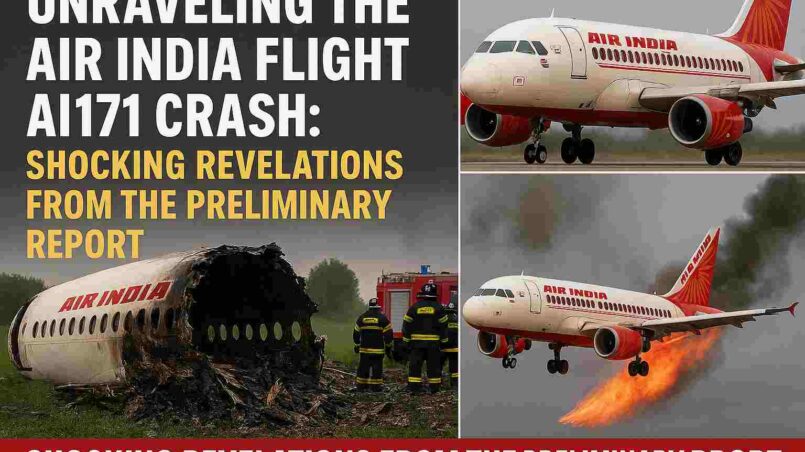
On June 12, 2025, Air India Flight AI171 took off from Ahmedabad, India. It was a Boeing 787-8 Dreamliner. Sadly, not long after takeoff, the plane crashed, and 260 people died. The Aircraft Accident Investigation Bureau (AAIB) has put out a first report about what happened. This blog is going to go over what they found, what happened during the flight, and what questions are still left hanging. I’ll try to explain things as simply as I can because this whole thing is pretty complicated and heartbreaking.
The Crash: What Happened on June 12, 2025?
On June 12, 2025, around 1:38 in the afternoon, Air India Flight AI171 had took off from Ahmedabad’s Sardar Vallabhbhai Patel International Airport, journey for London Gatwick. Everything seemed to be normal at the first, but just after the plane reached its top speed of 180 knots, something went wrong terribly . The fuel cutoff switches for both engines flipped from “RUN” to “CUTOFF” one after the other, just a second apart. That basically cut off the fuel, and both engines shut down while the plane was still in the air. It started dropping fast and ended up crashing into a medical hostel near the airport. Tragically, 241 of the 242 people onboard died, along with 19 others on the ground.
The Aircraft Accident Investigation Bureau (AAIB) put out a 15-page preliminary report on July 12, 2025. It’s the first official look into what happened, but it still leaves a lot of questions open like why the fuel cutoff happened in the first place. Was it human error? Mechanical failure? Or something else? We just don’t know yet.
The Timeline: A Minute-by-Minute Breakdown
To really get what happened in the crash, let’s break down the timeline from the AAIB report, but I’ve switched it to Indian Standard Time to keep it clear:
At 11:17 AM, the Boeing 787-8 with the registration VT-ANB landed in Ahmedabad from Delhi as Flight AI423. The crew noticed a fault with something called the “STAB POS XDCR” that’s short for Stabilizer Position Transducer, which basically tells how the horizontal stabilizer at the back of the plane is positioned. By 12:10 PM, Air India’s maintenance team had fixed the problem, and the plane was good to go for its next trip, AI171 heading to London.
Around 12:35 PM, the flight crew showed up at the boarding gate. There was a captain acting as the Pilot Monitoring and a co-pilot flying the plane. Both were based in Mumbai, had rested well the night before, and passed their breathalyzer tests. Then, at exactly 1:38:39 PM, Flight AI171 took off with 230 passengers onboard 15 in business class and 215 in economy, including two infants. The plane’s weight and fuel were all within safe limits.
Just three seconds later, at 1:38:42 PM, the plane hit 180 knots its top speed. That’s when the fuel cutoff switches for both engines flipped to “CUTOFF,” one second apart, cutting fuel to the engines. Five seconds after that, at 1:38:47 PM, the Ram Air Turbine (RAT), which is a backup system that helps with hydraulic power, kicked in. But it wasn’t enough to keep the plane flying low.
At 1:38:52 PM, the pilots switched the fuel back to “RUN” for Engine 1. Four seconds later, they did the same for Engine 2. Engine 1 fired up again, but Engine 2 didn’t respond.
At 1:39:05 PM, the pilots sent out a “Mayday” distress call to Air Traffic Control. Just six seconds later, at 1:39:11 PM, the Flight Data Recorder stopped marking when the plane crashed.
All this happened in less than half of a minute after just takeoff, which shows just how fast and chaotic those moments must have been in the cockpit.
The Stabilizer Issue: A Red Flag?
Before this flight took off, the crew who flew it from Delhi to Ahmedabad noticed a problem with something called the stabilizer position transducer, or STAB POS XDCR for short. The horizontal stabilizer is what helps control the plane’s pitch basically, how it tilts up and down. If that sensor is acting up, it could mess with how pilots keep the plane balanced. Air India’s maintenance team fixed the issue and gave the plane the green light to fly. But the report doesn’t say for sure if the problem was completely sorted out or if it had anything to do with the crash.
That leaves an important question hanging: Did the stabilizer problem play a part in what happened, or was it totally unrelated to the fuel cutoff?
The Fuel Cutoff Mystery: Pilot Error or Mechanical Failure?
The strangest part of the report is how the fuel cutoff switches flipped to “CUTOFF” right after takeoff. These switches control the fuel going to the engines and have a special locking mechanism to stop them from being moved accidently by pilots. To turn them off, a pilot has to pull the switch up first, then move it so just bumping them by mistake is really unlikely.
In the cockpit voice recorder, one pilot asks, “Why did you cut off (the fuel)?” and the other answers, “I did not do so.” That short back-and-forth has caused a lot of heated discussion ever since.
Theories About the Fuel Cutoff
Pilot Error: Some folks think maybe one of the pilots turned off the fuel switches on purpose or by accident. That question, “Why did you cut off?” makes it sound like one pilot suspected the other did it intentionally. But the copilot quickly reply, “I did not do so,” along with how fast they tried to restart the engines in less than 10 seconds, which makes deliberate sabotage seem unlikely. Both pilots were seasoned and professionals, the main captain had over 15,000 flight hours, and the co-pilot had around 3,400 and there was no sign of any mental health issue or being under any influence.
Mechanical or Software Malfunction: Another theory is that something technical went wrong. Back in 2018, the FAA warned that some Boeing planes including the 787 had fuel control switches with locks that could come loose, making it easier to accidentally flip them. Air India didn’t follow up on that advisory since it wasn’t mandatory. So, it’s possible a faulty switch or a glitch in the plane’s engine control software (called FADEC) made the switches look like they were off, or actually stopped the fuel flow. The report doesn’t say for sure, but they’re still looking into it.
Unexplained Cause: The report doesn’t point fingers at the pilots or Boeing outright. It even says no safety recommendations have been made yet for Boeing or the GE GEnx-1B engines. That leaves the door open for something else, like an electrical problem or some system acting on its own without being told to.
Why Blame the Pilots?
The report’s focus on the pilots’ conversation has led some to suspect a rush to blame the deceased crew, who cannot defend themselves. The Airline Pilots Association of India and Air Marshal Sanjeev Kapoor, a senior Indian Air Force official, have criticized about the report, by suggesting it leans toward pilot error without providing enough evidence. Mr. Kapoor argued that turning off both fuel switches within a second, especially during takeoff, is impossible for even the most experienced pilots.
The lack of the full cockpit voice recording in the report fuels suspicion. Why did the AAIB include only one line of conversation? What did the pilots say afterward? Releasing the full transcript could clarify whether the pilots were troubleshooting a malfunction or if one acted deliberately.
Boeing’s Role and Stock Surge
Once the AAIB report came out, Boeing’s stock went up, reaching its highest point in a year. That tells you a lot investors seem to think Boeing might not be to blame since the report didn’t call for any actions against the company or GE. But there’s still the 2018 FAA warning about those faulty fuel switches, which makes you wonder if Boeing and Air India could’ve done more to stop this from happening. Plus, Air India didn’t check the switches after that advisory because it wasn’t mandatory, which only adds more fuel to the debate.
What’s Next for the Investigation?
The preliminary report is just the beginning report. The AAIB is still digging through the wreckage, checking fuel samples, going over black box data, and talking to witnesses. They expect to release a full, detailed report in about a year, which should answer a lot of questions and offer safety recommendations. For now, though, a few big questions are still up in the air:
Was the stabilizer problem really fixed, or did it play a part in the crash? Did a mechanical glitch or software bug cause the fuel to cut off, or was it pilot error? Why hasn’t the full cockpit voice recording been made public yet? Could following the 2018 FAA advisory more closely have stopped this tragedy?
The AAIB has also moved the wreckage to a secure place for deeper study, and experts from the U.S. NTSB stand for National Transportation Safety Board, GE, and Boeing are helping with the investigating issue.
The Bigger Picture: Transparency and Accountability
This crash one of the worst for an Indian airline in many years has led to a wave of public anger and serious calls for transparency. Families of those who lost their lives, along with aviation experts, are pushing hard for the full black box recordings to be made public. The fact that the AAIB report only shared selected parts has made people wonder: Is the investigation more focused on protecting companies than finding the truth?
While waiting for the final report, the loss of Flight AI171 stands as a painful reminder of why strict safety measures , honest communication, and real accountability are very important matter in aviation industry. Whether the cause was by the human error, or technical fault, or something more complex, however people always deserve honest answers. That’s the only way to truly honor the victims and make sure something like this doesn’t happen again in future.